


Most guides to Maltese residency programs are drafted for a global audience rather than one situated in the particular tax posture of United States citizens, and the omission is readily apparent: such materials typically lead with the 15% flat tax rate and proceed no further, an incomplete treatment given that the IRS taxes US citizens on worldwide income and gains irrespective of country of residence. Malta does not displace that obligation; what Maltese programs provide instead are instruments — a stable base within the EU and, in certain circumstances, a favourable tax regime — that interact with a client’s existing US obligations in ways that are specific and predictable. This guide addresses both programs with that interaction squarely in view.
The two programs are not the same instrument
MPRP and GRP are frequently marketed together, which invites the assumption that they are variants of a single product. They are not. Each is designed to resolve a distinct concern, and an applicant’s threshold task is to determine which one actually applies to their specific circumstances.
MPRP (the Malta Permanent Residence Programme) confers a residence status. It secures for the applicant and qualifying family members the right to reside in Malta on a permanent basis, imposes no minimum-stay obligation, and carries the practical benefits of proximity to Europe together with visa-free travel within the Schengen Area subject to 90/180-day rule. Standing alone, MPRP effects no change whatsoever to the applicant’s tax position: Malta imposes tax only upon those who also establish Maltese tax residency, a status that MPRP does not by itself confer.
GRP (the Global Residence Programme) confers a tax status. It is designed for individuals seeking to establish genuine Maltese tax residency and thereby access the 15% flat rate applicable to foreign-source income remitted into Malta. It carries its own property and income thresholds, entirely distinct from those governing MPRP.
Many clients ultimately pursue both — MPRP to secure the permanent right of residence, and GRP (or, for European Union nationals, its counterpart the TRP) to secure the intended tax treatment — but the two remain separate applications addressing separate objectives, and an American client should be clear on which is actually required before committing resources to either.
MPRP: what it costs, and what it leaves untouched
Under the reform effected by Legal Notice 146 of 2025, the MPRP fee structure presently comprises the following:
- Administration fee: €60,000 per standard application, payable in two installments — €15,000 upon submission and €45,000 following issuance of the Letter of Approval in Principle— plus €7,500 for each adult dependant other than the spouse.
- Government contribution: a unified €37,000, payable irrespective of whether the qualifying property is purchased or rented.
- Qualifying property: purchase or long-term lease in Malta or Gozo, to be retained for a minimum of five years.
- Philanthropic donation: €2,000
- Processing time: officially stated as four to six months, with a one-year temporary residence permit available to bridge the interim period.
For an American family, the material point concerns what MPRP does not accomplish: it does not, of itself, confer Maltese tax residency, and it alters not a single line item of the applicant’s United States tax return. A client who already files an FBAR (mandatory once aggregate foreign account balances exceed $10,000) or Form 8938 under FATCA (mandatory once foreign assets exceed the applicable threshold, beginning at $200,000 for single filers residing abroad) will find that MPRP, taken alone, adds nothing to that existing obligation — though the acquisition of Maltese property and the opening of Maltese accounts will.
Accordingly, MPRP, deployed on its own, functions as a genuine contingency instrument: permanent European residence held in reserve, to be activated if and when circumstances warrant, without disturbing the client’s existing United States tax position.
GRP: what actually changes once Maltese tax residency is elected
GRP is where the substantive interaction with US tax law commences, and it is here that the governing details carry the greatest consequence.
Under the terms currently in effect, and available until the program’s sunset:
- 15% flat tax on foreign-source income remitted to Malta.
- Minimum annual tax of €15,000, which covers the first €100,000 of foreign income remitted; amounts remitted in excess of that figure are taxed at 15% on the surplus.
- Property threshold of €275,000 for purchase (€220,000 in Gozo or South Malta) or €9,600 annually for lease (€8,750 in Gozo or South Malta).
- Application fee of €6,000.
- No fixed minimum-stay requirement, provided the applicant does not spend more than 183 days in any single other jurisdiction during the year.
The controlling deadline: effective January 1, 2027, GRP will be subsumed into a new Individual Tax Programme pursuant to Legal Notice 195 of 2026, under materially less favourable terms — the minimum annual tax rising from €15,000 to €35,000, higher property thresholds, and a new five-year renewal cycle carrying recurring fees. Applications submitted on or before December 31, 2026 will be grandfathered under the present terms through 2031. For any American client giving serious consideration to GRP, this deadline constitutes the single most time-sensitive fact bearing on the decision.
Actual interaction between GRP and US tax
Three mechanisms govern this interaction, and each is commonly treated with insufficient care:
1. The treaty applies, but the saving clause constrains its effect. The United States–Malta income tax treaty, in force since 2011, affords genuine relief — principally a tax-credit mechanism permitting tax paid in one jurisdiction to offset liability owed in the other. Nearly every United States tax treaty, however, contains a saving clause, which preserves the United States’ right to tax its own citizens substantially as though the treaty did not exist. As a practical matter, American applicants therefore receive materially narrower treaty protection than non-United States applicants, and any relief must be claimed through the specific mechanism of a foreign tax credit rather than presumed as a blanket exemption.
2. FATCA reporting continues irrespective of the applicant’s awareness of it. Because Malta and the United States operate under a Model 1A FATCA agreement, Maltese financial institutions report account information to Malta’s tax authority, which in turn exchanges that information with the IRS. This process is largely invisible to the client in day-to-day terms, but its consequence is that no American-connected asset held in Malta escapes disclosure; planning should proceed on the assumption of full transparency from the outset.
3. Malta’s remittance basis and the United States’ worldwide-income rule do not align, and this misalignment is the detail that most affects outcomes. GRP taxes only that foreign income which the applicant remits into Malta; income retained offshore and never remitted goes untaxed by Malta. The United States draws no such distinction — it taxes the applicant’s full worldwide income without regard to remittance. Consequently, the foreign tax credit offsets United States tax only on the remitted portion of income, being the portion on which offsets United States tax only on the remitted portion of income, being the portion on which Malta actually imposed tax. Income retained offshore to preserve the benefit of Malta’s remittance basis remains fully subject to United States tax, with no available credit, because no foreign tax was ever paid against it. GRP’s advantage to American clients is therefore genuine, but considerably narrower than the headline 15% rate suggests in isolation.
A worked illustration
*Illustrative only, and not to be construed as tax advice; outcomes depend on income character, structuring, and individual circumstances, and should be reviewed with a qualified cross-border tax advisor prior to any decision.
Consider an American couple earning $400,000 (approximately €370,000) annually from consulting and investment income, evaluating Maltese residence.
Scenario A — MPRP only; no election of Maltese tax residency
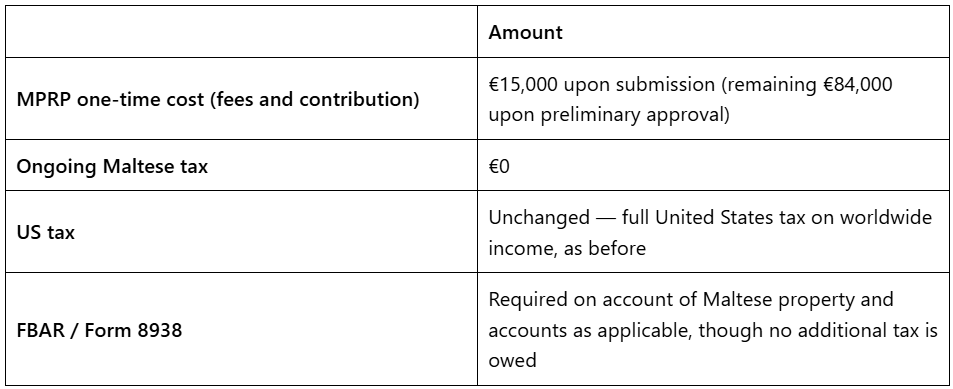
The couple obtains permanent EU residence as strategic optionality. No aspect of their United States tax return is altered.
Scenario B — GRP elected; €200,000 remitted to Malta annually, €170,000 retained offshore
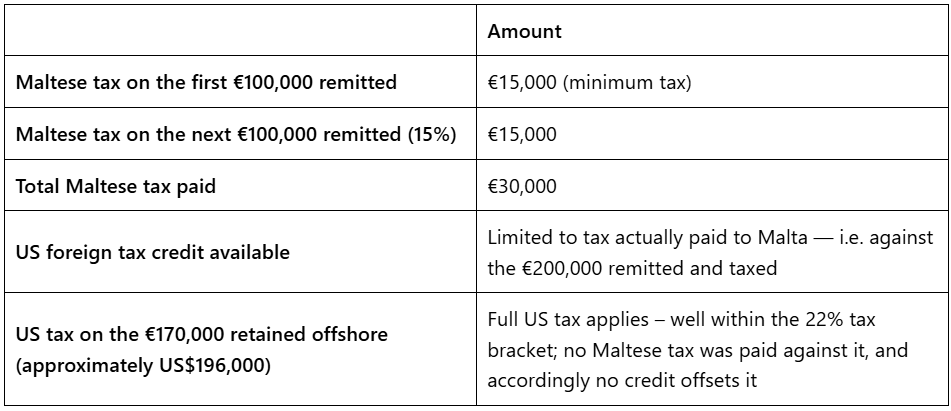
The family reduces double taxation as to the portion it elects to remit, but the portion retained offshore to preserve the benefit of Malta’s remittance basis remains fully exposed to United States tax without offset.
Which program fits an American applicant:
- MPRP alone is appropriate where the objective is a European foothold — insurance against instability or preservation of future optionality — while keeping existing US tax planning fully intact.
- MPRP together with GRP is appropriate where the client is holds substantial foreign-source income intended for remittance into Malta, and stands to benefit from the treaty’s credit mechanism on the remitted portion. The €15,000 minimum tax under GRP is a flat cost triggered the moment any amount is remitted, and it already covers the first €100,000 remitted, meaning the cost of remitting up to that threshold is fixed regardless of how much is actually brought in. The planning question, then, centers on which years call for remitting close to €100,000 (or beyond, at 15%) – best answered by looking at the US side of the ledger, since it turns on how the foreign tax credit actually applies.
- In either case, a qualified US cross-border tax advisor should be engaged before filing, with the full structure decided together, since what looks like the obvious choice on its own can shift once every variable — entity structure, remittance timing, credit baskets, FBAR, FATCA, and the treaty’s saving clause — is weighed as a whole.
Weighing MPRP, GRP, or both? Reach out to our team at Finco Trust to schedule a call — we’ll help map out the structure that actually fits your specific circumstances.